

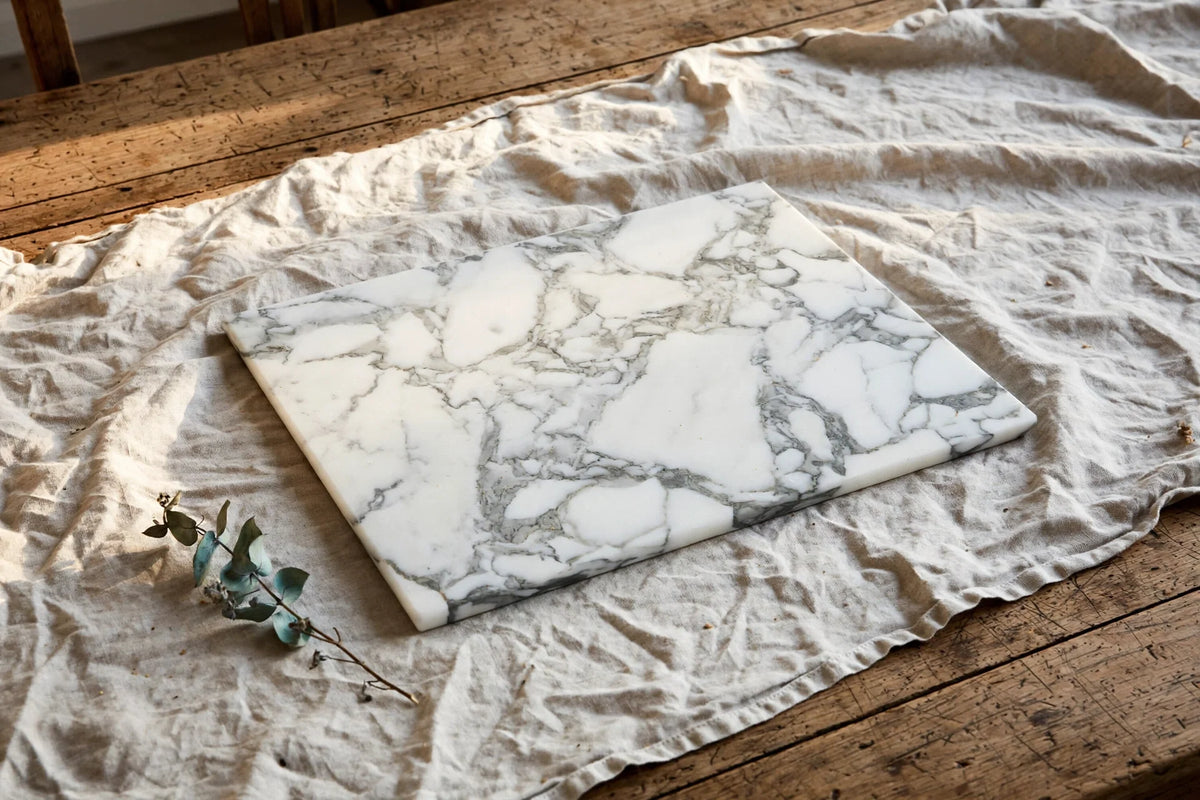
Thanksgiving is the one meal where the table does the talking. A stone board stays cool under cheese and pie, holds a chill through a long dinner, and turns a pile of food into something that looks intentional. That is why it belongs at the center of the table — not hidden in a cabinet.
The honest limit, up front: marble hates acid and sudden heat, and a chip in the surface is a food-safety problem, not a cosmetic one. This guide sorts the Thanksgiving table dish by dish — what goes straight on stone, what needs a bowl or a trivet, and what stays off the board entirely.

In This Guide
- 1. The Short Answer: What Goes On, What Does Not
- 2. What Stone Does Best at Thanksgiving
- 3. The Three Things That Hurt Marble
- 4. Marble vs Granite at the Table
- 5. The Food-Safety Rules
- 6. What Our Customers Ask Most
- 7. After the Feast: Cleanup in Ten Minutes
- 8. Frequently Asked Questions
- 9. The Bottom Line
1. The Short Answer: What Goes On, What Does Not
Most of Thanksgiving belongs on stone. The exceptions are acid, screaming-hot pans, and raw meat — each with a simple workaround.
| Goes straight on stone | Needs a bowl, liner, or trivet | Stays off the board |
|---|---|---|
| Cheese, charcuterie, bread | Cranberry sauce (bowl) | Raw turkey (separate board) |
| Sliced cooked turkey | Hot gravy boat (trivet) | Citrus cut directly on marble |
| Pie, cake, desserts | Red wine glasses (coaster, wipe drips) | Roasting pan straight from the oven |
| Butter, chilled appetizers | Vinegar-dressed salad (bowl) | A chipped or cracked board |
If you remember one rule: dry and cold is safe on any stone; wet, acidic, or very hot needs a barrier — and the barrier can be as simple as a bowl or a folded cloth.
2. What Stone Does Best at Thanksgiving
Stone earns its place at the table on the cold and dry jobs — cheese, bread, desserts — where its cool surface is a feature, not a risk.
Cheese, charcuterie, and bread
Cheese stays firm and butter does not slump on a chilled stone board — this is the job stone was made for.
Chill the board in the fridge for 30–60 minutes before guests arrive and it holds that cold through a long dinner. Cheese, cured meats, crackers, and bread look staged on veined stone rather than merely placed — one board covers the appetizers and the presentation.
Pie, cake, and dessert
Stone is a pastry slab first and a serving board second — pie dough, in particular, behaves better on it.
Pastry dough stays firm instead of softening on contact, butter holds its shape, and a pie cools evenly on stone. Bakers have used stone slabs for centuries — it is physics, not marketing. Serve the pie on the same board you rolled it on, and the table gets a centerpiece for free.

Sliced turkey and cold sides
Sliced, cooked turkey is fine on stone — carve it on a separate board first, then arrange the slices for serving.
Cold sides can sit directly on the board, cranberry sauce aside. The one habit to keep: wipe the board when the food comes off, not the next morning.
3. The Three Things That Hurt Marble
Marble's three enemies at Thanksgiving are acid, sudden heat, and chips — and all three are avoidable with a bowl, a trivet, and a quick look at the board.
Acid: cranberry sauce, wine, citrus, vinegar
Acid left sitting on marble etches it — a dull spot that is a chemical burn, not a stain, and no cleaner removes it.
Marble is a calcareous stone, built mainly on calcium carbonate, and mild acids attack it on contact. The Thanksgiving table is full of them: cranberry sauce, red wine, citrus garnish, tomato, and vinegar dressing. Serve acidic dishes in a bowl that sits on the stone, never directly on it, and wipe any drip the moment you see it. For the full mechanism, see our marble etching vs. staining guide.
Sudden heat: the roasting pan problem
A pan straight from the oven can crack stone — not because the stone is weak, but because one hot spot heats faster than the rest.
Granite typically resists heat up to about 250 °C (480 °F), according to the Natural Stone Institute, but a hot spot or steep thermal gradient can still start a crack — and marble has no verified heat number at all, only the same warning in words. Always put a trivet or a folded cloth between a hot dish and the stone.
Chips and cracks: retire the board, do not serve on it
A chipped edge is not just cosmetic — the FDA Food Code requires food-contact surfaces to be smooth and free of breaks, cracks, chips, and pits.
Check the board before the meal, not during it. A board with a chipped edge or a crack goes back in the cabinet for the day; serve on a different board. Stone is hard but brittle — a drop onto tile can chip an edge that would have survived as wood, so carry large boards with two hands.
Good to know: Sealing slows staining; it does not prevent etching. A sealed marble board still needs acidic food kept in a bowl — the sealer is an impregnator that makes stone stain-resistant, not stain-proof, and it cannot stop acid from reacting with the surface.
4. Marble vs Granite at the Table
Pick the stone by the job: marble for cold serving and looks, granite for carving and heat, quartzite in between.
| Stone | Best Thanksgiving job | Watch out for |
|---|---|---|
| Marble | Cheese, desserts, presentation | Acid etches; needs a trivet |
| Granite | Carving, hot dishes, daily use | Still dulls knives; seal it |
| Quartzite | Hard use + pale looks | Costs more; seal it |
Marble: the serving specialist
Choose marble if the board's job is to look beautiful and stay cool — it is the best-looking stone at the table.
Marble is the stone the USDA names in its cutting-board guide, and it has the longest pastry tradition. Its trade-off: it stains and etches more easily than granite or quartzite, so acidic food stays in a bowl and spills get wiped promptly. Our Arabescato marble board is the serving-first pick; for marble specifically, see can you use marble as a cutting board.
Granite: the hardest-working stone at the table
Choose granite if you want the board that carves the turkey — it is the toughest of the three and the most forgiving.
Granite resists stains and etching far better than marble, and in bacteria-retention studies cited by the Natural Stone Institute it performed better than most other countertop surfaces. It absorbs very little water — typically just 0.05% to 0.40% by weight — and most granite countertops do not need sealing at all. One correction: granite is slightly porous, not nonporous — the sealer is what makes it food-safe. Our Paradiso granite board is the carving pick; the care routine is in our granite pastry-board care guide.

Quartzite: the pale stone that works hard
Choose quartzite if you want marble's pale look with granite-like toughness.
Quartzite starts life as sandstone and is transformed into a dense, hard stone — it holds up to daily use while staying light in color. Like granite, it still needs sealing, and it still dulls knives. Our White Macaubas quartzite board is the pale-but-tough option. Still torn between stone and wood? Our marble vs wood cutting board guide compares the two across 7 differences.

5. The Food-Safety Rules
Three rules cover the whole meal: keep raw and cooked apart, use a smooth sealed surface, and sanitize the board that touched raw meat.
One board for raw, another for everything else
Separation is the rule, not the material — stone does not exempt you from it.
The USDA's guide is consistent on this: use one board for fresh produce and bread, and a separate board for raw meat, poultry, and seafood. The raw turkey gets its own board — never the board the cheese or the sliced turkey will sit on — and that board gets washed with hot soapy water right after use.
The surface must be smooth and sealed
A sealed, smooth surface is easy to clean and sanitize — and it never develops the deep knife scars where bacteria hide.
The USDA lists marble among the nonporous cutting-board surfaces consumers may choose, noting they are easier to clean than wood. That only holds while the surface is smooth and the seal is intact: check the water test before the holiday — sprinkle water on the board; if it beads, the seal is fine; if it soaks in and the stone darkens, reseal. There is no honest calendar interval; let the water test, not the calendar, tell you when. For the full trade-off, see our stone cutting boards pros and cons guide.
Sanitize the board that touched raw meat
Hot soapy water after each use, plus the USDA's standard sanitize step for the raw-meat board, is the whole routine.
To sanitize: 1 tablespoon of unscented liquid chlorine bleach per gallon of water, flooded over the surface, left to stand for several minutes, then rinsed clean. That step is only for the board that touched raw meat — the serving boards just need hot soapy water and a prompt dry.
6. What Our Customers Ask Most
At home, the board I reach for at Thanksgiving is the large Arabescato marble cutting board.
7. After the Feast: Cleanup in Ten Minutes
Wash, dry, and put it away flat — the whole routine is under ten minutes, and doing it tonight is what keeps the board looking new next year.
Wash and dry by hand
Mild soap, warm water, soft cloth — then dry promptly so water does not sit on the seal.
Clean natural stone with a neutral cleaner, a stone soap, or a mild liquid dish detergent and warm water — never with lemon or vinegar cleaners, which are acids and will etch marble. Never put stone in the dishwasher: heat and detergent dull the finish and weaken the seal.

What to avoid tonight
Three things damage stone boards after a big meal: the dishwasher, acids left sitting, and stacking them wet.
Wipe wine, cranberry sauce, and gravy promptly — especially on marble. Do not stack stone directly on stone while it is still damp; dry each board and store it flat. And check the water-bead test once the board is dry: if the water no longer beads, that is the time to reseal, not next Thanksgiving.
8. Frequently Asked Questions
Can you serve food directly on a marble board?
Yes — for dry and cold foods like cheese, bread, and desserts. Acidic or wet foods (cranberry sauce, wine, citrus, vinegar dressing) go in a bowl on the board, not directly on it, and drips get wiped immediately.
Can you put a hot turkey on marble?
Not straight from the oven. A roasting pan or a very hot dish needs a trivet or a folded cloth underneath — marble has no verified heat limit, and even granite, which typically resists heat up to about 250 °C (480 °F), can crack from a local hot spot.
Can you cut raw turkey on a stone board?
Yes, on a separate board kept away from cooked food — then wash it with hot soapy water and sanitize it with the bleach solution (1 tablespoon unscented bleach per gallon of water, rinsed clean). Never use the serving board for raw meat.
Will red wine stain marble?
It can etch and stain if left sitting — red wine is both acidic and strongly pigmented. Wipe it up the moment it spills, and keep wine glasses on coasters rather than directly on the stone.
Ready to set the table in stone?
Start with the job you do most. Our Arabescato marble board is cut for cheese, pastry, and serving; the Paradiso granite board is the carving workhorse; the White Macaubas quartzite board is the pale-but-tough middle ground. Each piece has its own veining, so no two are alike. Browse all 24 in the Stone Cutting Boards collection.
Shop Stone Cutting Boards9. The Bottom Line
Stone belongs at the Thanksgiving table — for the cheese, the pie, and the sliced turkey it is the best board you own. Keep the acid in a bowl, the hot pan on a trivet, and the raw turkey on its own board, and the stone will do the rest. Buy it for the jobs it wins, and it will be back on the table next year looking the same.
If stone is what's missing, browse Koville's Stone Cutting Boards collection — marble, granite, and quartzite, in medium and large. New to stone in the kitchen? Start with can you use marble as a cutting board.


Share:
Stone Cutting Boards: 7 Pros and 7 Cons, Honestly